Entrepreneurship Mindset for Researchers: Turning Research Skills into Real-World Impact
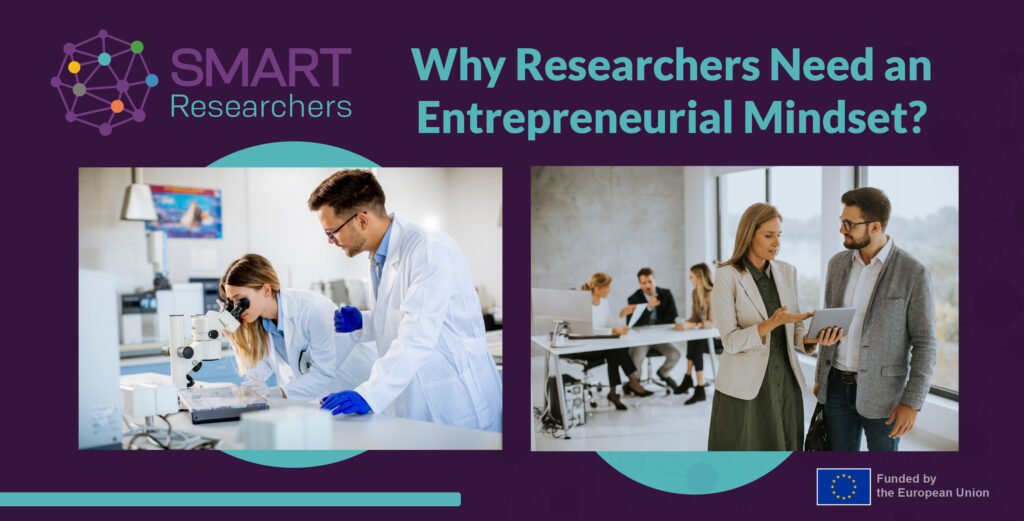
When researchers hear the word entrepreneurship, many immediately think of startups, investors, and pitching. Yet an entrepreneurial mindset is much broader, and far more relevant, than launching a company. At its core, it is a way of thinking that enables people to transform knowledge into value for society, industry, policy, and communities.
Today’s labor market is expanding and evolving rapidly, requiring a broad set of skills and an entrepreneurial mindset across nearly all professions, including research. Researchers are increasingly expected not only to generate knowledge but also to identify opportunities, collaborate across sectors, and translate ideas into practical impact.
At the same time, research careers are becoming more diverse. Many researchers move between academia, industry, the public sector, and innovation ecosystems throughout their careers. An entrepreneurial mindset equips them to navigate this dynamic environment with confidence, helping them recognize opportunities, adapt to change, and maximize the societal value of their work.
What an entrepreneurial mindset is - and what it isn’t
An entrepreneurial mindset refers to a way of thinking that encourages individuals to recognize opportunities, take initiative, and transform ideas into innovative and valuable outcomes.
For researchers, an entrepreneurial mindset is not about “commercialising science” or leaving academia. It is about approaching research with a broader perspective on how knowledge can create impact. This includes:
– Identifying meaningful problems that are worth solving,
– Understanding who benefits from the research and in what ways,
– Communicating the value of ideas and findings clearly,
– Testing assumptions early and learning through experimentation, and
– Building collaborations that help translate knowledge into real-world impact.
In essence, an entrepreneurial mindset is a set of habits and perspectives that help researchers move from knowledge creation to value creation, regardless of whether their career path leads them within academia, industry, the public sector, or beyond.
Five mindset shifts that help researchers increase impact
By adopting new ways of thinking, researchers can better connect their work with societal needs, open up diverse career pathways, and translate knowledge into meaningful impact. Researchers can adopt five key mindset shifts:
1) From “project-first” to “problem-first”
Researchers often start with a topic, method, or hypothesis. An entrepreneurship mindset adds one essential question upfront: what problem are we solving – and for whom?
A problem-first approach makes it easier to connect your work to real needs and to explain its relevance to stakeholders. It also helps you prioritise what matters most in a complex research process.
2) From “novelty” to “value proposition”
Scientific novelty is essential. However, outside academia, a common question is: what changes because this research exists?
This is where a value proposition becomes important. A value proposition is a clear and concise statement that explains:
– Who the work is intended for,
– What benefit it provides, and
– Why it is better or different from existing solutions or approaches.
3) From “certainty” to “testing assumptions”
Researchers are trained to be rigorous and cautious, strengths that should never be lost. The entrepreneurship mindset adds speed and learning through early testing.
Instead of building a perfect solution in isolation, you validate key assumptions quickly:
– Is this a real pain point?
– Do stakeholders actually need this?
– Will the solution fit into existing workflows?
– Are there barriers (cost, regulation, incentives, skills) that could block adoption?
4) From “publication only” to “translation and communication”
Publications are essential, but impact requires translation. That means adapting your message to different audiences:
– What a peer reviewer needs is not the same as what a policymaker needs,
– What an SME cares about differs from what a citizen cares about.
Clear communication is not “dumbing down.” It is a professional skill that increases trust, relevance, and uptake.
5) From “solo expert” to “collaboration and networks”
Most real-world challenges are interdisciplinary and require partnerships. An entrepreneurship mindset encourages you to invest in networks and co-creation, not as an extra task, but as part of impactful research.
Collaboration can take many forms: joint pilots, advisory input, policy dialogues, industry validation, user involvement, or co-designed training. The key is to treat stakeholders as partners in learning, not just as “end users.”
Why it matters now for advancing research careers and creating impact
Developing an entrepreneurial mindset helps researchers:
– Increase the visibility and adoption of their work,
– Communicate more effectively with diverse stakeholders,
– Identify opportunities for collaboration, funding, and innovation, and
– Expand career possibilities across academia, industry, and the public sector.
An entrepreneurial mindset does not replace scientific excellence, it enhances it by creating clearer pathways for research to generate real-world value.
How SMART Researchers supports this direction
SMART Researchers aims to strengthen researchers’ skills and career readiness through practical tools, support services, and guidance that respond to real labor market and societal needs. Cultivating an entrepreneurial mindset aligns perfectly with this mission, helping researchers connect their expertise to opportunities for impact, whether through collaboration, innovation, policy engagement, or new career pathways.
But building an entrepreneurial mindset doesn’t happen overnight; it develops through practice. Start small: this week, try writing a one-sentence value proposition. You may be surprised at how much it changes the way you think about and communicate your research.