Voices of early-stage researchers: Mladenka Novaković Bežanović
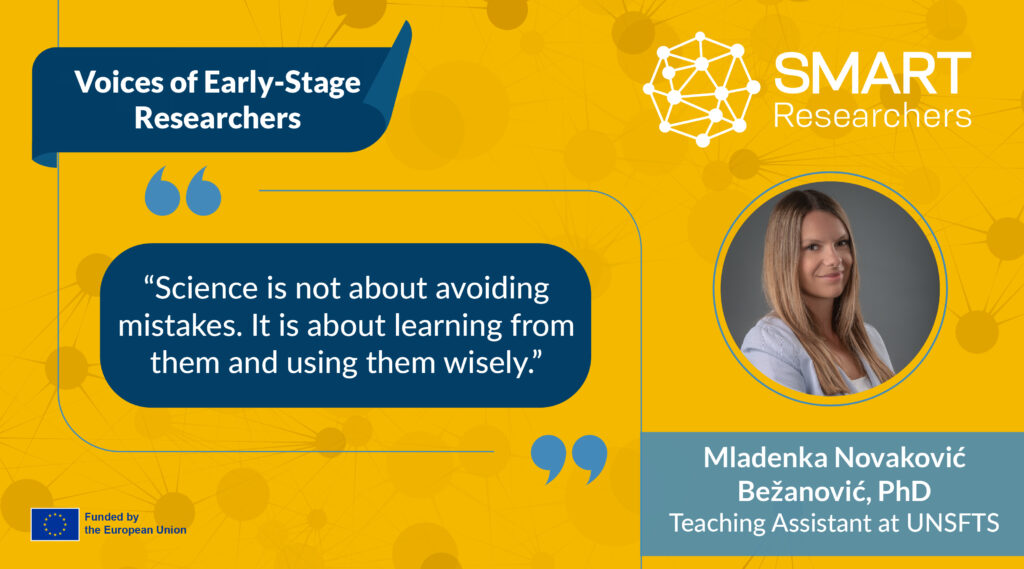
Mladenka Novakovic Bezanovic, Teaching Assistant with a PhD at the University of Novi Sad, Faculty of Technical Sciences, reflects on her research journey, the challenges she has faced, and the experiences that have shaped her scientific career.
What motivated you to choose your research field or topic, and how did you get started?
Right after defending my master’s thesis, I knew that working in academia was my true calling. Being part of the academic community felt both inspiring and challenging. It required me to step outside of my comfort zone and embrace new responsibilities. Environmental engineering is a multidisciplinary field filled with endless opportunities for growth. At the beginning of my doctoral studies, I chose to focus on wastewater treatment. However, as I worked closely with my research team, my scientific interests gradually expanded into other related areas. What started as one focused path evolved into a broader and more dynamic research journey.
How did you learn the skills and methods needed at the beginning of your research career?
At the start of my career, I developed the necessary research skills through continuous learning and dedication. I spent countless hours studying current environmental challenges to build strong theoretical foundations. However, the most significant turning point was laboratory work in environmental protection research. Practical experience allowed me to transform theory into meaningful scientific contributions. In addition, I developed my academic writing and presentation skills through continuous participation in scientific conferences. Every presentation, every discussion, and every question helped shape me into a more confident researcher.
Which tools, software, or research infrastructure have been most helpful in your daily work?
In my daily research activities, I use standard tools such as Word and Excel. For advanced data analysis and graphical representation of results, I rely on modern statistical software packages. For project-related tasks and visual communication, I also use Canva, which helps me present ideas clearly and creatively.
Which career-related resources (mentoring, training, mobility programs, networks) have supported your professional growth so far?
I have been fortunate to benefit from numerous professional development opportunities. Summer schools, short-term mobility programs, and specialized trainings in environmental protection and occupational health and safety have all played an important role in shaping my professional identity. These experiences strengthened not only my technical knowledge but also my analytical thinking and adaptability.
How do you collaborate with supervisors, colleagues, or project partners?
At the very beginning of my doctoral studies, I became part of a team of outstanding professionals who share similar scientific interests. That collaboration did not end with the completion of my PhD, it continues to this day. Their selfless knowledge sharing and unwavering support have been invaluable. Working together on research and teaching activities has led to many of my professional achievements.
Can you share a moment when collaboration helped you achieve something significant?
There have been many significant moments made possible through collaboration. But if I had to choose one, it would be the moment we successfully published several scientific papers. Especially during times when we believed we might not overcome the obstacles in front of us. Those moments taught me resilience and trust in teamwork.
How do you build professional networks, online or at conferences, and how has that helped your research?
Conferences have been the most important place for building professional connections. Engaging with researchers who share similar interests has helped guide my future research directions and inspired the integration of new topics into ongoing projects.
How has mentorship or coaching influenced your development as a researcher?
Mentorship has been a crucial element of my journey. Without timely guidance, constructive feedback, and a professional relationship built on trust, progress in one’s area of expertise would be far more difficult. moguć.
What has been the biggest challenge in your research, and how did you overcome it?
The biggest challenge in my research journey has been the path from writing to publication. Not every day is the same. There were moments of doubt and frustration. However, through persistence and continuous improvement in interpreting research results, every obstacle was eventually overcome. I learned that growth often happens in the most difficult phases.
Have you faced limitations related to funding, infrastructure, or institutional support? How did you handle them?
Fortunately, I did not face significant financial limitations during my experimental research. My team’s readiness to transform every idea into action has always been unwavering.
How do you manage setbacks or unexpected results?
I treat every unexpected result as a new opportunity. It is not a failure. Each outcome offers guidance for improvement. Science is not about avoiding mistakes. It is about learning from them and using them wisely.
How do you balance research workload, deadlines, and personal life as an early-stage researcher?
Balancing research workload and personal life can be challenging. However, with good organization and the support of loved ones, everything becomes manageable. I achieve work–life balance through flexible scheduling and remote work whenever physical presence is not required.
How do you see your research contributing to society or advancing your field?
Because my field is multidisciplinary, its societal impact is undeniable. My doctoral research has the potential to serve as a foundation for improving wastewater quality and environmental protection systems. My ongoing research focuses on expanding expertise in environmental protection and occupational health and safety, contributing to safer and more sustainable systems.
What career paths are you currently considering, and how does your institution support these options?
In the coming years, I aim to deepen my expertise in environmental management systems and occupational health and safety. I am also highly motivated to strengthen my project management skills to successfully implement complex research and sustainability initiatives.
Which emerging trends, technologies, or approaches in your field excite you the most?
What truly excites me is the implementation of modern sustainable technologies in environmental protection and occupational safety. The integration of innovation and sustainability has the power to reshape our future, and I would be honored to contribute to that transformation.
What advice would you give to researchers in general?
If I could share just a few guiding principles that have motivated me, they would be: Follow your dreams. Stay persistent. Understand that the path to great scientific achievements is filled with ups and downs. Choose wisely, especially the team that stands beside you. Work with people who make you feel fulfilled, valued, and motivated.