Voices of Research Mentors: Dr Milica Solarević
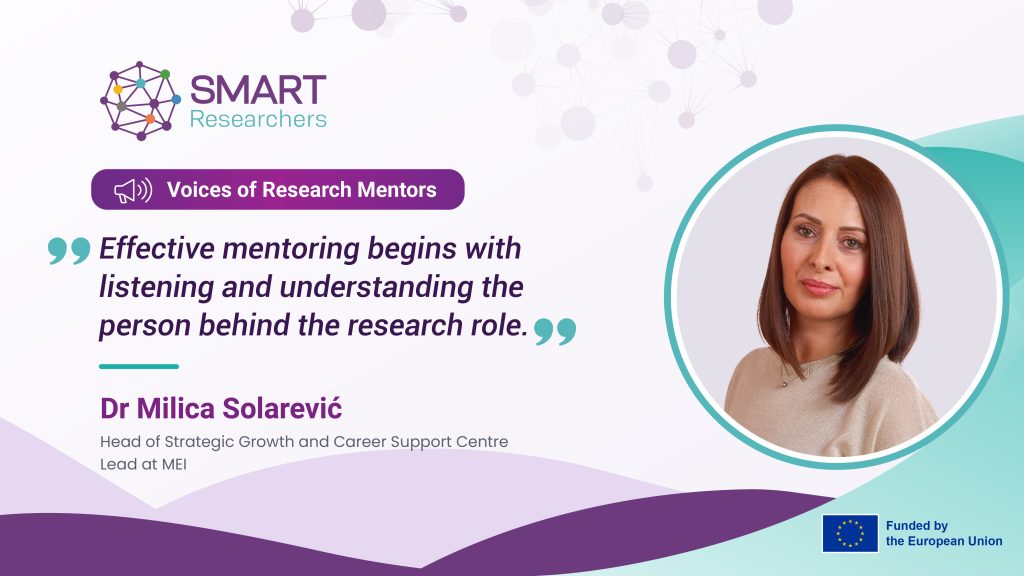
Behind every early-career researcher who finds their direction, there is often someone who helped them ask the right questions. In our Voices of Research Mentors series, we talk to the people who take on this role and learn how they support researchers at the start of their careers.
We spoke with Milica Solarević, Head of Strategic Growth and Career Support Centre Lead at Minds Europe – Institute for Research Excellence and Technological Advancement. Her work links institutional development, partnerships and new opportunities with the professional development of the institute’s researchers.
As a mentor, Milica helps early-career researchers reflect on their goals, recognise their strengths and identify practical next steps. She works with them on individual development plans, offers career guidance and connects them with people whose expertise can help them move forward.
Find out how she helps researchers turn today’s experience into career opportunities within and beyond academia.
What does effective mentoring mean to you?
For me, effective mentoring begins with listening and understanding the person behind the research role. Researchers have different ambitions, circumstances, skills, potential, openness, and definitions of success, and the guidance we offer should reflect that. A mentoring conversation should allow someone to speak openly, receive honest feedback and leave with a clearer sense of what to do next. It also requires follow-through: returning to the goals we discussed and considering what has changed. Over time, I want that relationship to strengthen the researcher’s confidence in making their own decisions.
What are the main challenges you see early-career researchers facing today?
One of the main challenges is making long-term career decisions while working within short-term projects and contracts. Immediate responsibilities can leave little room to consider which skills to develop, which opportunities to pursue or what comes next. Researchers also face expectations to publish, contribute to proposals, collaborate and communicate their work to different audiences. In that environment, it can be difficult to distinguish between being busy and making progress towards a personal career goal. Mentoring can help create the space to consider that distinction.
What kind of support do researchers most often need at the beginning of their careers?
At the beginning, researchers need orientation and a sense of direction. They need to understand expectations, recognise what they already bring to the role and identify where further experience would help. Practical support matters too: feedback on a CV, advice on a learning opportunity or an introduction to someone with relevant expertise. An individual development plan can bring these elements together. I would keep the first steps manageable, so that development feels achievable alongside their work and they understand why each step matters.
How do you support early-career researchers in navigating these challenges?
I begin with a conversation about their goals, current responsibilities and the questions they are trying to resolve. Together, we identify priorities and translate them into practical next steps through individual development planning. Depending on their needs, support may include mentoring, feedback on a CV or research profile, information about training, funding or mobility, or a discussion about a career transition. I also involve colleagues with research or innovation expertise where appropriate. Through our newly established Centre, we are making this support more consistent, with clearer access and follow-up.
What skills do you think researchers need most in today’s research environment?
Strong research skills, critical thinking and integrity remain the foundation. Alongside them, researchers need to communicate clearly, collaborate across disciplines and sectors, manage project responsibilities and use digital tools responsibly. From my strategic growth perspective, I would also highlight the ability to recognise where their expertise can make a useful contribution. That means understanding a partner’s needs, explaining the relevance of their work and identifying opportunities worth pursuing. Being able to describe their own contribution clearly is valuable both in research collaboration and when considering a future role.
What approaches do you find most effective for helping researchers develop new skills?
I find it useful to connect learning with a task the researcher actually needs to complete. Preparing a presentation, updating a research profile or contributing to a proposal can provide a concrete starting point for development. The next step is to identify suitable guidance, learning resources or a colleague who can offer feedback. Reflection matters as well: what did they find difficult, what improved and where do they need more practice? This makes development relevant to their work and helps us choose learning opportunities with a clear purpose.
What role can peer learning, networking, and collaboration play in researchers’ career development?
They give researchers access to perspectives and practical knowledge they may not encounter in their immediate work. A conversation with a peer can make an unfamiliar task more manageable; collaboration can reveal a new application for their expertise. Networks also help researchers understand how different organisations and sectors work. In my role, I see value in helping them identify relevant connections and approach those conversations with a clear interest or contribution. As we develop career-related cooperation through the Centre, this is the kind of exchange we want to encourage.
Where do you see gaps in the support currently available to researchers?
Continuity is a significant gap. At MEI, our initial assessment identified informal mentoring and training linked mainly to individual projects. Establishing the Career Support Centre gives us a permanent point of access and a clearer framework for development conversations and follow-up. We are still at an early stage, so the next task is to understand how researchers use that support and where we need to adjust it.
How can institutions create an environment where mentoring and career development become an integral part of research careers?
Institutions need to give career development a clear place in how work is organised, starting with onboarding. That requires named responsibilities, allocated time, regular development conversations and support for the people providing mentoring. In a small organisation like ours, a workable approach combines existing staff expertise with external resources and cooperation. Trust is equally important. Researchers should be able to discuss their ambitions confidentially, understand the advisory nature of the conversation and request another adviser when needed. These arrangements make support both accessible and credible.
What changes would make the biggest difference to researchers’ career development and working experience?
Earlier career conversations and time to act on them would make a substantial difference. For someone on a project-based contract, discussing the future well before the engagement ends creates room to build relevant experience and prepare for different possibilities. I would also like to see broader recognition of contributions such as collaboration, knowledge sharing, project work and engagement beyond academia. Recognising those contributions helps researchers understand the full value of their experience and gives them a stronger basis for deciding what to pursue next.
What is one area where you would like to see greater support for early-career researchers?
I would prioritise career transitions, particularly for researchers on fixed-term or project-based contracts. They need time and guidance to take stock of their experience, recognise transferable skills and explore where those skills could be useful. Through the Centre, we can support that reflection and provide feedback on CVs, research profiles and portfolios. We are also developing partnerships and planning career exposure activities to broaden their understanding of different professional environments. Making an informed choice is easier when researchers have had an opportunity to see what those environments involve.
What would you like to see become a standard part of every early-career researcher’s career journey?
I would like every early-career researcher to have access to a trusted mentor and a regular, meaningful conversation about their development. That conversation should lead to a few clear priorities, realistic actions and opportunities to review progress. It should also leave room for ambitions to change as researchers gain experience. I would want them to feel comfortable saying, “I am reconsidering my direction,” and know there is someone they can turn to. Having that continuity of support can help them approach career decisions with greater clarity and confidence.