Voices of early-stage researchers: Dunja Istrat
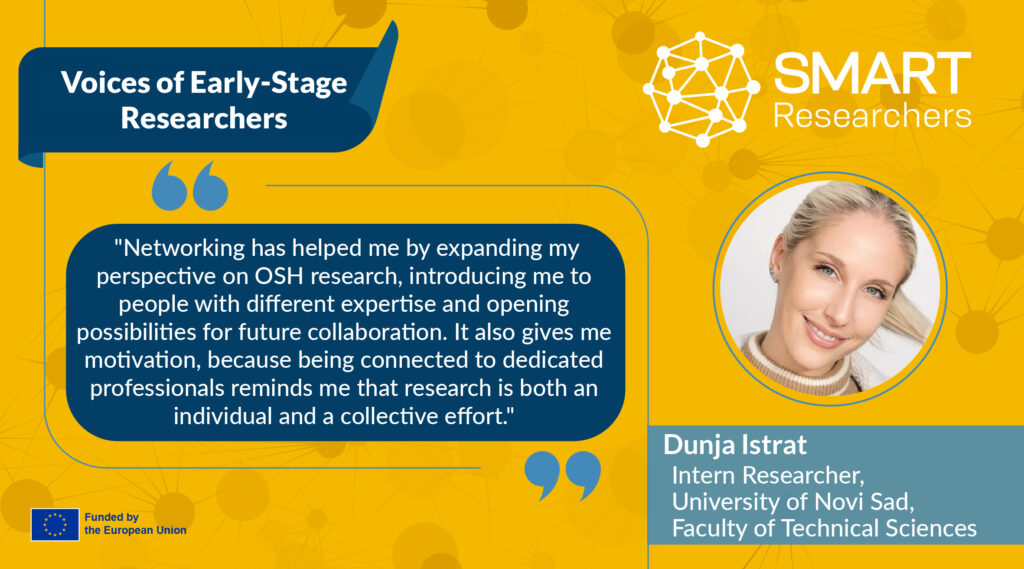
Dunja Istrat, a PhD student and intern researcher at the Faculty of Technical Sciences, University of Novi Sad, in the field of Environmental and Occupational Safety Engineering, reflects on her research journey, the challenges she has faced, and the experiences that have shaped her scientific career.
What motivated you to choose your research field or topic, and how did you get started?
I chose Occupational Safety and Health (OSH) because I believe it is a field where research can have a direct and meaningful impact on people’s lives. It connects science, engineering, prevention and real working conditions, which I find very valuable. What motivates me most is the possibility to contribute to safer and healthier environments, while also continuously learning and improving myself.
I got started through my academic path at the Faculty of Technical Sciences, University of Novi Sad, at the Department of Environmental Engineering and Occupational Safety and Health. Through my studies and later my involvement as a junior researcher and in teaching practice, I became even more aware of how important OSH is in both education and industry.
My PhD topic is still being defined, but I have already done a literature review on the application of digital twin technology in OSH and that process strengthened my interest in the field even more. I find it very exciting to explore how emerging technologies can support risk prevention, decision-making and safer work systems.
How did you learn the skills and methods needed at the beginning of your research career?
At the beginning of my research career, I learned mostly through a combination of formal education, guidance from more experienced colleagues and a lot of independent work. I believe the early stage of research is a period where you learn not only methods and tools, but also how to think critically, ask better questions and organize your work.
I learned step by step, through reading scientific papers, participating in research-related tasks, discussing ideas with mentors and colleagues and improving through practice. I also learned a lot by being involved in teaching activities and working with students, because explaining concepts to others helps me understand them more deeply.
In addition to technical and research skills, I also had to learn how to adapt, communicate with different people and manage expectations. For me, developing as a researcher has been equally about methodology and personal growth.
Which tools, software, or research infrastructure have been most helpful in your daily work?
In my daily work, the most helpful tools are those that support literature review, writing, organization and communication. Scientific databases and journal platforms are essential for following current research and building a strong theoretical foundation, especially while defining a PhD topic.
For writing and organizing research materials, I rely on common academic and productivity tools (document editing, spreadsheets, presentation tools and reference organization). Communication and collaboration tools are also very important, especially when working with colleagues, project teams and students.
At the institutional level, being part of the Faculty of Technical Sciences and my department has been very valuable because it gives me access to an academic environment where I can consult colleagues, exchange ideas and stay connected to both teaching and research practice. For me, that combination of infrastructure and people is one of the most useful parts of daily research work.
Which career-related resources (mentoring, training, mobility programs, networks) have supported your professional growth so far?
Several types of resources have supported my professional growth so far, but mentorship and collaboration have probably had the strongest impact. Having support from experienced colleagues and mentors helped me better understand how research develops in practice, not only academically, but also professionally.
Training opportunities, project-related activities and interactions with researchers from different backgrounds have also been very important. I value spaces where knowledge and experience are exchanged openly, because they help me grow faster and more confidently.
I also see mobility programs and international project networks as very important for young researchers. They offer exposure to different approaches, work cultures and research priorities. Even when the experience is challenging, it helps build independence, adaptability and a broader perspective, all of which are essential for long-term development.
How do you collaborate with supervisors, colleagues, or project partners?
I try to build collaboration on clear communication, mutual respect and reliability. I believe good collaboration is not only about expertise, but also about how people work together, share responsibilities and support each other.
With supervisors and senior colleagues, I appreciate open discussions, constructive feedback and guidance that helps me improve while still encouraging my independence. With colleagues and project partners, I try to be professional, responsive and solution-oriented, especially when tasks require coordination across different roles or timelines.
I also value collaboration in teaching and project activities because it helps me learn from different perspectives. In my experience, the best results come when people are willing to share knowledge openly and work as a team toward a common goal.
Can you share a moment when collaboration helped you achieve something significant?
One meaningful example is my involvement in teaching activities at the department, especially practical sessions with students. Working together with colleagues in preparing and delivering exercises helped me improve not only the quality of the teaching process but also my own confidence and professional skills.
That collaboration was significant for me because it showed how much can be achieved when knowledge, experience and support are shared. I learned a lot from colleagues’ advice, their way of communicating with students and their approach to organization and responsibility.
It also helped me build a professional but approachable relationship with students, which I am very proud of. For me, that is an important achievement, because education and research are strongly connected and working well with others has played a major role in my development.
How do you build professional networks, online or at conferences, and how has that helped your research?
I build professional networks gradually, through conferences, academic events, project activities and everyday professional communication. I try to approach networking in a genuine way, not just to “collect contacts”, but to build meaningful connections based on shared interests, mutual respect and knowledge exchange.
Online platforms are useful for following researchers, institutions and current topics, while conferences and in-person events are especially valuable for direct conversations. Those interactions often give me new ideas, different perspectives and practical insights that I might not get from reading alone.
Networking has helped me by expanding my perspective on OSH research, introducing me to people with different expertise and opening possibilities for future collaboration. It also gives me motivation, because being connected to dedicated professionals reminds me that research is both an individual and a collective effort.
How has mentorship or coaching influenced your development as a researcher?
Mentorship has had a very important role in my development, both professionally and personally. Good mentors do more than share knowledge, they help you develop your way of thinking, build confidence and grow through challenges. Through mentorship, I have learned how to approach research more critically, how to be patient with the process and how to keep improving even when progress feels slow.
I have also learned the importance of balance: setting goals that are realistic and achievable, but still ambitious enough to keep me motivated. What I appreciate most is supportive guidance combined with trust. When someone gives you advice, but also believes in your potential, it can make a big difference, especially at the beginning of a research career.
What has been the biggest challenge in your research, and how did you overcome it?
My biggest challenge has often been myself, especially learning how to manage my own expectations, push my limits in a healthy way and stay motivated through uncertainty. Early in a research career, it is easy to feel pressure to do everything quickly and perfectly, but I have learned that growth takes time.
I worked on this by becoming more aware of my goals and by trying to set them in a way that is both realistic and ambitious. I wanted goals that are achievable, but also strong enough to keep me motivated and moving forward.
I also learned not to compare myself to others in an unhealthy way. Other people can inspire and motivate me, but my main focus is on becoming a better version of myself. That mindset has helped me stay more optimistic, consistent and resilient.
Have you faced limitations related to funding, infrastructure, or institutional support? How did you handle them?
Like many early-stage researchers, I have experienced situations where resources, time, or infrastructure are not ideal. In research, there is often a gap between what you would like to do and what is realistically possible at a given moment.
When that happens, I try to focus on what can be done well with the resources available: improving planning, prioritizing tasks, seeking advice from colleagues and looking for alternative ways to move forward. I have found that flexibility and good communication are very important in these situations.
At the same time, support from my team and institution has been meaningful, especially through mentorship, collaboration and inclusion in teaching and project-related activities. Even when there are limitations, a supportive professional environment makes it much easier to continue developing.
How do you manage setbacks or unexpected results?
I try to see setbacks and unexpected results as part of the research process, not as failure. Of course, it is not always easy in the moment, especially when you invest a lot of time and energy, but I have learned that these situations often bring the most valuable lessons.
My first step is usually to pause, analyse what happened and separate emotion from the problem. Then I try to understand whether the issue comes from the method, the assumptions, the timing, or something else. If needed, I ask for feedback from mentors or colleagues, because an external perspective can be very helpful.
What keeps me moving forward is the combination of support from people around me and my own long-term goals. I remind myself why I started, what I want to build and how each challenge can strengthen me as a researcher.
How do you balance research workload, deadlines, and personal life as an early-stage researcher?
Balancing research, deadlines and personal life is still something I am continuously learning. I do not think there is a perfect formula, especially in the early stages, but I try to manage it through planning, prioritization and realistic expectations.
I usually work by setting clear short-term and long-term goals and by breaking larger tasks into smaller steps. That helps me stay focused and reduces the feeling of being overwhelmed. I also try to be honest with myself about what is possible within a certain timeframe.
Equally important, I have learned that support from family, friends and my team plays a huge role. Their encouragement helps me stay grounded and motivated. For me, balance is not about doing everything perfectly every day, but about staying consistent while protecting my energy and motivation over time.
How do you see your research contributing to society or advancing your field?
I see my research interest in OSH, especially the exploration of digital twin applications in this field, as a way to contribute to safer, more proactive and better-informed work environments. Even at this early stage, I am motivated by the idea that research can support prevention, improve decision-making and help reduce risks before incidents happen.
OSH is a field with strong social relevance because it directly affects workers’ health, safety and quality of life. That is why I believe even theoretical and early-stage research can be important if it helps build better frameworks, methods, or future applications.
I also see contribution through education. My involvement in teaching allows me to connect research thinking with students’ development, which I believe is another meaningful way to strengthen the field in the long term.
What career paths are you currently considering, and how does your institution support these options?
At this stage, I am primarily focused on developing as a researcher and educator and I see my future in a path that combines research, teaching and practical contribution in the OSH field. I am interested in work that allows both academic growth and real-world impact.
I am open to different directions in the future, including academic research, project-based work, interdisciplinary collaboration and applied research connected to industry and practice. What matters most to me is staying in an environment where learning, contribution and cooperation are valued.
My institution supports this development through the academic and professional environment at the Faculty of Technical Sciences, especially through mentorship, collaboration opportunities and my involvement in teaching and departmental activities. That experience helps me build both scientific and professional competencies.
Which emerging trends, technologies, or approaches in your field excite you the most?
What excites me most right now is the growing use of advanced digital technologies in OSH, especially approaches that support prediction, simulation and prevention. Since I have already explored the literature on digital twin applications in OSH, this is one of the areas I find particularly promising.
I am interested in how digital twins, data-driven monitoring and other smart technologies can improve risk assessment and decision-making in complex work systems. I think their value is especially strong in prevention, because they can help identify problems earlier and support more proactive safety management.
More broadly, I am excited by interdisciplinary approaches that connect engineering, safety science, data analysis and human factors. I believe the future of OSH will increasingly depend on that kind of integration.
What advice would you give to researchers in general?
My advice would be: stay curious, stay patient and do not build your progress only on comparison with others. It is good to be inspired by people around you, but the most important comparison is with your previous self.
Research is not only about results, it is also about learning how to think, adapt, communicate and keep going when things are uncertain. Set goals that are realistic, but still ambitious enough to motivate you. Let them challenge you in a healthy way.
Also, do not underestimate the importance of people. Mentors, colleagues, students, friends and family can make a huge difference in your journey. Support, collaboration and genuine knowledge exchange are not secondary to research, they are part of what makes research possible and meaningful.