Voices of early-stage researchers: Ivana Biondić Jazbec
Ivana Biondić Jazbec obtained her Master’s degree in Finance from the Faculty of Economics and Business at the University of Zagreb in 2017 and spent a semester at Chemnitz University of Technology in Germany through the ERASMUS+ programme. She currently works as a Research Assistant in the Department for European Policies and is pursuing a PhD in Economics through a joint doctoral programme of the University of Innsbruck and the University of Linz in Austria. Her research focuses on the influence of EU policies on the public policies of Member States and countries involved in the enlargement process, with a special emphasis on Cohesion Policy.
What motivated you to choose your research field or topic, and how did you get started?
I started my work right after graduating from University. I have had some interest in the field before I started working at the Institute. Still, real interest came after getting the job, with an understanding supervisor who included me in many projects, through which I learned a lot and began to take more interest in my research field.
How did you learn the skills and methods needed at the beginning of your research career?
I mostly learned skills and methods through supervisors’ guidance, summer/winter schools, workshops, online (free) seminars, and YouTube tutorials. However, it is still in progress, and I need to stay in line with new trends, which are emerging daily.
Which tools, software, or research infrastructure have been most helpful in your daily work?
In my daily work, I mostly use Stata for large-scale data analysis and Office (Excel and Word) for smaller data sets. For other needs, I use Grammarly when needed.
Which career-related resources (mentoring, training, mobility programs, networks) have supported your professional growth so far?
I got a supervisor when I started working and took multiple training sessions in the field, e.g., summer/winter schools, workshops, and seminars.
How do you collaborate with supervisors, colleagues, or project partners?
In my opinion, we have a good collaboration. For my PhD, my supervisor regularly reads my papers (draft versions) and gives me feedback. I collaborate with colleagues daily, either in the office or remotely, via live or online meetings. With project partners, we collaborate as needed (sometimes it is daily and sometimes weekly), depending on the project phase.
Can you share a moment when collaboration helped you achieve something significant?
A key moment of collaboration was when I faced a methodological data challenge that was slowing down my PhD studies. Instead of solving it alone, I discussed it with a colleague, and through a short session he identified a simpler analytical approach. This not only improved the quality of the results but also saved me a significant amount of time.
How do you build professional networks, online or at conferences, and how has that helped your research?
I build professional networks mostly through colleagues and project partners, less at conferences, and basically none online. My professional network is now larger than ever and has significantly helped my research, as meeting people from the same or similar research fields broadens my knowledge.
How has mentorship or coaching influenced your development as a researcher?
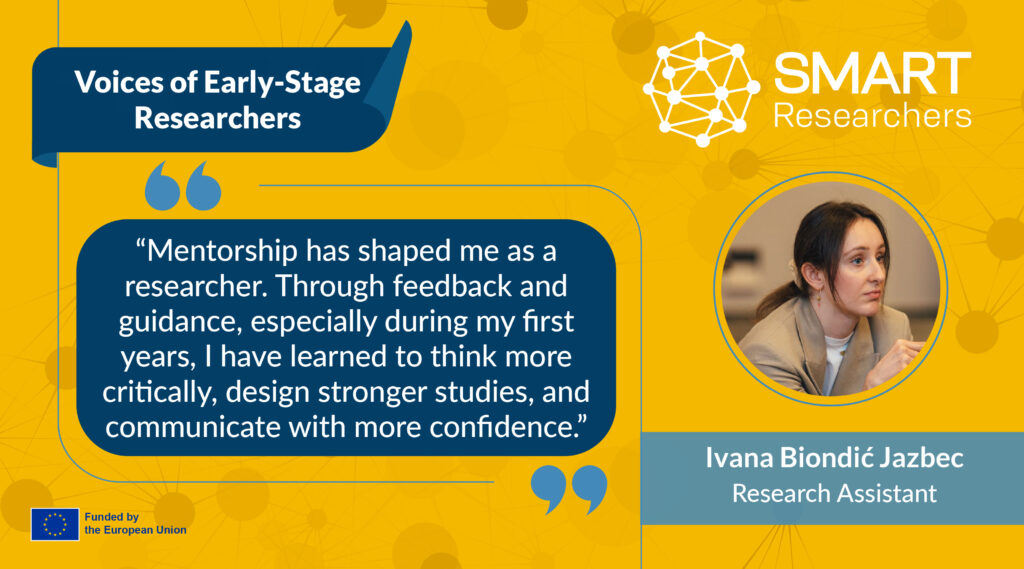
Mentorship has shaped me as a researcher. Through feedback and guidance, especially during my first years, I have learned to think more critically, design stronger studies, and communicate with more confidence. I also received support to work at the faculty as an external associate, which helped me gain more confidence in public speaking. Projects we worked on have made the process even more meaningful and helped me learn more analysis tools.
What has been the biggest challenge in your research, and how did you overcome it?
The biggest challenge was (and still is) getting the PhD, since it is difficult mentally, as it takes so long, and after some years, you feel tired from the same research, and you want to move forward to a new topic, but still have to finish the study.
Have you faced limitations related to funding, infrastructure, or institutional support? How did you handle them?
In my first years of research, funding was limited, and I had an older (slow) computer, which could not handle my larger databases. I handled it by using my private computer. I had no other funding, infrastructure, or institutional support, as all my communicated needs were met.
How do you manage setbacks or unexpected results?
At first, I took it personally and felt bad after a review (for example), but now I see it as advice from senior colleagues, which I learn from.
How do you balance research workload, deadlines, and personal life as an early-stage researcher?
In my opinion, I balance it well. In research, there are phases with more and less workload, so it evens out. When there are deadlines, it is normal to work more, and I anticipate it in advance and plan accordingly. Also, when there is less workload, I adapt it and have more personal time.
How do you see your research contributing to society or advancing your field?
Since I work in EU funds and policies, policy recommendations can help efficiently use funding, thereby promoting the stable growth of fund recipients. Also, we conduct funding evaluations, which can help define better-tailored tenders for EU funds in the field.
What career paths are you currently considering, and how does your institution support these options?
Currently, I plan to finish my PhD in the next few months and start working as a postdoctoral researcher in the same field. My institution fully supports this.
Which emerging trends, technologies, or approaches in your field excite you the most?
I am excited about new statistical packages. For example, I had a large panel data set when I first started working in 2018, which Stata could not analyse, but now it can. So, the program is improving, and data can be analysed in greater depth.
What advice would you give to researchers in general?
To early-stage researchers, I would say to have patience – they do not know everything, and it takes time to learn, but they will get there. Do not take any feedback personally; it is just one way to learn and improve in the field.
To experienced researchers, to have more patience with young colleagues, to spend more time explaining and guiding them, and to be there for them.