Voices of Early-Stage Researchers: Ivana Manevska
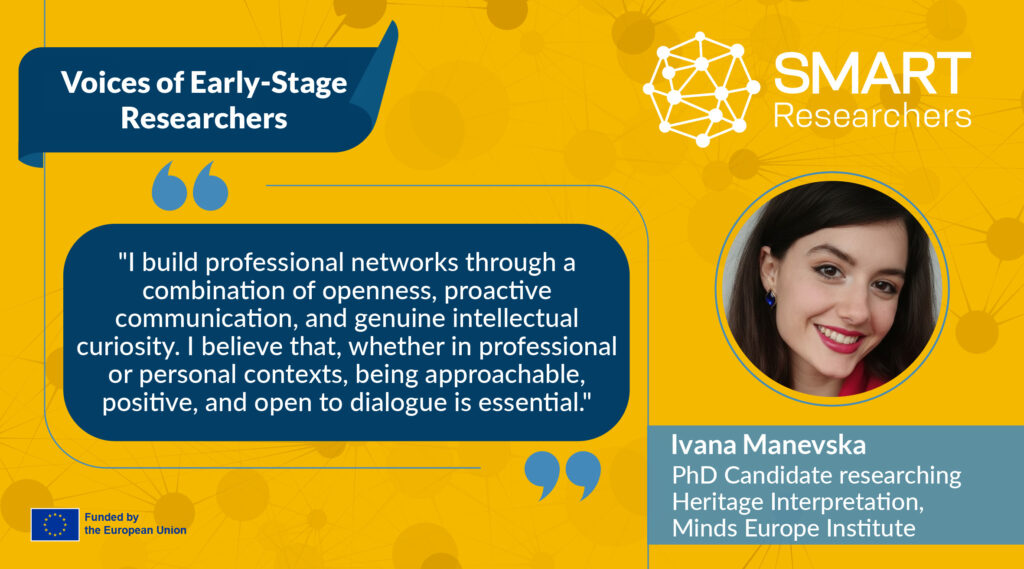
Ivana Manevska, a PhD candidate in Heritage Interpretation, shares insights into the beginnings of her research career, the mentors who shaped her path, the experience she gained at the Minds Europe Institute, and the challenges that have contributed to her growth as a researcher.
What motivated you to choose your research field or topic, and how did you get started?
I often reflect on my academic beginnings. From an early age, I was driven by a deep curiosity about the world, a desire to travel, to explore new places, to experience unfamiliar situations, and to understand my surroundings from different perspectives. This curiosity naturally guided me toward studying tourism, a field that beautifully combines everything I am passionate about nature, culture, history, people, adventure, heritage, gastronomy, and countless other dimensions of human experience.
During my academic development, particularly throughout my Master’s studies in Cultural Tourism, I encountered the concept of interpretation of natural and cultural heritage. That moment marked an important turning point for me. I realized that interpretation was not merely an academic concept, but a powerful tool through which I could contribute personally and professionally to the way people perceive and understand the world around them. I recognized in it the opportunity to leave a meaningful personal imprint, provided that I dedicated myself to mastering and thoughtfully applying this field.
My research journey formally began with my Master’s thesis, which focused on the interpretation of the natural and cultural heritage of Fruška Gora. This work laid the foundation for my continued academic engagement in the field. Over time, I expanded my research through various scholarly papers addressing different aspects of heritage interpretation, examining both personal and non-personal interpretive methods and their application in diverse contexts.
My primary motivation for researching interpretation stems from a strong conviction that heritage must be accessible, engaging, and meaningful to all. I firmly believe that only through understanding can people truly value and preserve what surrounds them. The world we live in is extraordinarily rich and beautiful, yet its significance unfolds only when we take the time to discover, interpret, and appreciate it. I pursue this understanding daily, both privately through travel and personal exploration, and professionally through my research at Minds Europe Institute, as well as at the Faculty of Sciences of the University of Novi Sad, where I am currently a PhD candidate in Geotourism.
How did you learn the skills and methods needed at the beginning of your research career?
I began developing my research skills during my undergraduate studies, when I was first introduced to field research methodology through collaborative, group-based projects. This experience marked my initial structured engagement with the research process and allowed me to connect theoretical knowledge with its practical application in real-world settings.
During my Master’s studies, I further strengthened my methodological competencies through independent field research, which required a higher level of autonomy, responsibility, and analytical thinking. At the same time, I acquired foundational skills in statistical data analysis, particularly through the use of SPSS software for processing and interpreting survey data collected via questionnaires. This phase of my academic development was especially important, as it enhanced my precision in data interpretation and deepened my understanding of quantitative research approaches.
Throughout my PhD studies, I have participated in various research projects that significantly contributed to shaping my academic profile. During this period, I received strong and continuous support from faculty members, particularly from my mentor, Professor Đorđije Vasiljević. His professional guidance, expertise, and dedication played a crucial role in my intellectual and scientific growth. Under his mentorship, I learned to approach research in a more comprehensive, systematic, and scientifically responsible manner.
Simultaneously, through my engagement at Minds Europe Institute, I have been involved in numerous research initiatives under the mentorship of senior colleagues and experienced professors. Their extensive knowledge, methodological rigor, and practical guidance greatly contributed to my professional maturation. With their support, I developed the confidence and competence to independently design and conduct diverse types of research, while also learning how to thoughtfully navigate the challenges and obstacles that inevitably arise throughout the research process.
Which tools, software, or research infrastructure have been most helpful in your daily work?
In my daily research practice, I rely on a combination of analytical and organizational tools that support different stages of the research process:
- Excel – for data organization and preliminary data processing
- SPSS – for statistical analysis
- Google Forms – for data collection
- Google Colab – for analytical support and data processing
- Canva – for the visual presentation of research results
- ResearchGate – for tracking academic literature and staying updated with recent publications
- Consensus, NotebookLM, and Perplexity AI – for research support and reviewing contemporary scientific studies
Together, these tools enable me to maintain efficiency, methodological rigor, and systematic organization throughout the research process.
Which career-related resources (mentoring, training, mobility programs, networks) have supported your professional growth so far?
The most significant resource contributing to my professional development has undoubtedly been mentorship. From the very beginning of my academic journey, my mentor Professor Đorđije Vasiljević has guided me step by step through the entire research process. His support began with my Master’s thesis and continued through the writing of my first scientific paper, the publication of my initial research articles, and my participation in academic conferences. He provided strategic guidance on which research findings were most suitable for conference presentations and which were more appropriate for submission to scientific journals.
Equally important was his support in navigating communication with journal reviewers. He taught me how to respond constructively to critiques, how to improve manuscripts based on feedback, and how to transform reviewers’ comments into opportunities for strengthening the quality of scientific work. This mentorship not only improved my academic writing but also shaped my understanding of scientific standards and research integrity.
In addition to continuous academic guidance, my mentor encouraged me to participate in specialized training programs that expanded my professional competencies. Among them, I would particularly highlight two programs: the training organized by the World Federation of Tourist Guide Associations. (WFTGA) and the Certified Interpretive Guide training delivered by Interpret Europe. These experiences deepened my practical understanding of heritage interpretation and strengthened the connection between theory and application.
A particularly transformative experience was my Erasmus mobility during the third year of my PhD studies in Italy. During this internship, I worked with Carmen Granito, founder of the company “The Story Behind,” which focuses on heritage interpretation and branding. This experience allowed me to observe how interpretation and heritage branding projects function in practice. It provided me with valuable insight into the real-world application of the concepts I research academically, helping me bridge theory and practice in a much more comprehensive way.
Furthermore, my engagement with Minds Europe Institute has been an essential component of my professional growth. The institute has an international network of universities, research institutes, companies, and experts collaborating on innovative initiatives and significant research projects. Being surrounded by professionals from across Europe and the wider world, all striving for excellence within their respective fields, continuously motivates me to improve, to maintain high standards, and to pursue ambitious academic goals. I believe that such an environment is crucial for a young researcher, as it helps establish strong professional habits early on and sets standards of excellence below which one simply does not go.
Together, mentorship, specialized training programs, international mobility, and professional networks have shaped not only my academic path but also my work ethic, research standards, and long-term professional vision.
How do you collaborate with supervisors, colleagues, or project partners?
I collaborate with my academic mentor and research supervisors through both in-person and online meetings, depending on the nature of the project and current circumstances. Our communication is regular and structured, ensuring continuous feedback, strategic guidance, and alignment of research objectives.
At Minds Europe Institute, collaboration with mentors and project partners is similarly dynamic, combining virtual coordination with direct interaction whenever possible. This flexibility allows for efficient teamwork across different institutions and countries.
With my colleagues, particularly fellow PhD candidates, collaboration is highly interactive and intellectually stimulating. We co-author scientific papers, conduct joint research, develop project proposals together, and participate in conferences as a team. We actively support one another, sharing ideas, initiatives, and constructive feedback whenever possible. This exchange is especially valuable because, although each of us has a distinct research focus, our fields often intersect in meaningful ways. The multidisciplinary dimension of our collaboration adds depth, innovation, and broader perspectives to our work, ultimately strengthening both the research outcomes and our professional relationships.
I deeply value the opportunity to hear diverse perspectives, especially from senior colleagues, mentors, and project partners. Understanding how they approach specific research questions, how they interpret complex issues, and how they strategically think about projects significantly enriches my own analytical framework. I particularly appreciate participating in meetings and collaborative sessions where open discussions take place, where constructive critique is encouraged, and where new ideas and initiatives naturally emerge from intellectual exchange.
For me, collaboration is not only a practical necessity in research but also a source of inspiration, growth, and continuous learning.
Can you share a moment when collaboration helped you achieve something significant?
One particularly meaningful example of how collaboration helped me achieve something significant occurred during the first year of my PhD studies, when I volunteered at the Gallery of Matica Srpska in Novi Sad. After initially assisting with various activities, I became involved in a research project connected to the major monographic exhibition “Uroš Predić: A Life Dedicated to Beauty and Art,” organized on the occasion of the 175th anniversary of the Gallery.
During this period, I had the opportunity not only to guide tours and observe other guides in practice, but also to design and conduct a quantitative research study examining the impact of tour guides’ personal and interpersonal characteristics on visitor experience and satisfaction in an art exhibition context. We developed and validated the Tour Guide Performance Indicators Scale, which identified four key dimensions of guide performance: interpersonal skills and adaptability, knowledge and communication, professionalism and reliability, and support and safety. The findings confirmed that tour guides play a crucial role in shaping visitors’ overall experiences in cultural institutions.
This experience was transformative for me. It allowed me to connect theory and practice in a very tangible way, to observe how personal interpretation, storytelling, and communication style directly influence how visitors perceive and remember heritage. Seeing visitors’ engagement and emotional responses reinforced my belief in the power of interpretation. Heritage itself is often impressive, but when it is meaningfully interpreted, it becomes memorable and capable of leaving a lasting impact, even in a time when we are overwhelmed by information and constant distractions.
That project was one of the first moments that truly confirmed why I am passionate about researching heritage interpretation. It demonstrated how thoughtful interpretation can shape experience, deepen understanding, and even influence attitudes toward heritage preservation.
How do you build professional networks, online or at conferences, and how has that helped your research?
I build professional networks through a combination of openness, proactive communication, and genuine intellectual curiosity. I believe that, whether in professional or personal contexts, being approachable, positive, and open to dialogue is essential. I always strive to be communicative, respectful, and engaged in conversations, as meaningful professional relationships often begin with simple but authentic exchanges of ideas.
Online, I primarily use LinkedIn to connect with researchers and professionals who leave a strong impression on me, individuals who stand out through the quality, originality, or impact of their work. Their field of expertise does not necessarily have to align perfectly with my own research interests. I value interdisciplinary perspectives and often find inspiration in areas beyond my immediate specialization.
At conferences and academic events, I intentionally attend panels that are closely related to my research interests or that introduce innovative approaches within my broader field. During breaks and informal networking sessions, I make a conscious effort to engage with participants I have not met before. I find that discussing a panel session, exchanging impressions, or reflecting on key insights often leads to deeper professional conversations. In many cases, these interactions result in exchanging contact information and establishing ongoing communication.
So far, building these networks has significantly supported my research development. It has provided inspiration for new research topics and collaborations, helped me identify emerging directions within my field, and guided me toward experts I can consult when exploring new methodologies or theoretical approaches. Professional networking, for me, is not only about visibility but about intellectual growth and continuous learning through dialogue and collaboration.
How has mentorship or coaching influenced your development as a researcher?
Mentorship has had a profound impact on my development as a researcher. I must particularly emphasize the role of my PhD supervisor, Professor Dr. Đorđije Vasiljević, who has guided me throughout my Master’s and doctoral studies, as well as during the development of my dissertation. His mentorship has significantly shaped the way I think, work, and grow as a researcher.
From the very beginning, I received not only academic guidance but also genuine support and understanding. He consistently provided clear direction, constructive criticism, and practical, applicable advice. Whether during field research, manuscript preparation, or navigating academic procedures, he helped me see the broader picture and better understand how the academic world functions. His mentorship enabled me to approach research with greater structure, responsibility, and confidence.
In addition, through my work at Minds Europe Institute, I received valuable guidance from project coordinators and senior colleagues. Their advice on how to efficiently manage tasks, organize research activities, and approach complex projects was always clear and concrete. This practical dimension of mentorship strengthened my ability to work effectively within collaborative research environments.
I consider myself fortunate to have been surrounded by mentors who are not only knowledgeable and accomplished, but also dedicated, hardworking, curious, and grounded individuals. Observing their commitment and professional integrity encouraged me to ask deeper questions, continuously improve, and recognize how much can be achieved through discipline and perseverance.
Both academically and personally, my mentors inspire me to believe that my research goals are attainable. Their support and example have shown me that with the right guidance, environment, and dedication, ambitious scientific aspirations can become realistic and achievable outcomes.
What has been the biggest challenge in your research, and how did you overcome it?
I have not faced any major challenges in my research in terms of methodology or access to data; however, financial constraints have consistently been the most significant obstacle. Conducting research often requires funding, but budgets at my faculty are limited, especially for doctoral students. Similarly, publishing scientific papers and participating in conferences can be costly, which requires careful planning and resourcefulness.
To overcome these challenges, I have sought alternatives whenever possible: attending conferences online or selecting events with no registration fees, and submitting papers to journals that do not charge publication fees. This approach allows me to continue my research and dissemination efforts despite limited financial resources.
Another challenge is the lengthy peer-review process in academic publishing. From submission to acceptance, it can take several months or even years, which is demanding and exhausting for a researcher. During this time, it requires significant effort to stay connected to the topic and re-engage with the work, especially when reviewers request extensive revisions. Despite these difficulties, managing these processes has taught me patience, resilience, and careful planning, all of which are essential skills for a developing researcher.
Have you faced limitations related to funding, infrastructure, or institutional support? How did you handle them?
As I mentioned in my previous response, I have faced certain limitations related to funding, infrastructure, and institutional support. Conducting research often requires careful resource management, especially as the budget available to doctoral students is typically very limited. Most of us rely on scholarships, which are usually sufficient for basic living expenses but leave little room for additional research-related costs.
One significant challenge is the cost of accessing scientific publications. Many journals require paid subscriptions or article access fees, which can be prohibitive for a student. To overcome this, I often need to rely on the faculty library or other institutional resources to obtain the necessary materials. This process can be time-consuming and cumbersome, especially considering that thorough research often requires consulting numerous publications rather than just one or two. Despite these obstacles, learning to navigate limited resources has strengthened my ability to plan, prioritize, and approach research with resilience and creativity.
I make every effort to ensure that financial constraints do not affect the quality of my research or the results presented in my work.
At the same time, I am optimistic that the situation will improve in the future. As awareness grows and discussions around research funding and support continue, various initiatives by stakeholders, institutions, and policymakers both nationally and internationally can make a significant difference. Ideally, this would create a structured support system, ensuring that doctoral students and early-career researchers do not have to navigate these challenges alone, but rather have a framework that allows their research and scientific contributions to flourish.
I choose to remain optimistic because I believe that persistence, dedication, and constructive dialogue can gradually bring positive change to the research environment, making it more accessible and sustainable for emerging scholars.
How do you manage setbacks or unexpected results?
I approach failures or unexpected results as valuable learning opportunities. I strive to extract lessons from any research mistake, viewing it not as a failure but as an integral part of the research process that can help me anticipate challenges and improve my work in the future.
I do not give up at the first setback, nor do I rush to make conclusions. Instead, I carefully analyze the results, seeking to understand what insights can be gained and how they can inform subsequent steps. I aim to present findings in my publications as honestly and transparently as possible, while maintaining academic standards.
In some cases, if the results or the manuscript are not as strong as initially expected, I consider submitting to a less competitive journal rather than forcing the work into a venue where it may not meet the standards. This approach allows me to maintain scientific integrity while continuing to develop as a researcher.
How do you balance research workload, deadlines, and personal life as an early-stage researcher?
Balancing research, deadlines, and personal life is perhaps one of the most challenging aspects of being an early-career researcher, and honestly, I am still learning how to manage it effectively. I make a concerted effort to organize my time as efficiently as possible, using calendars, daily to-do lists, and reminders to structure my work.
Despite careful planning, I often find myself working late into the night, making sacrifices in my personal time. For example, during my annual vacation, I received reviewer comments on a manuscript and needed to address them immediately. I spent three days working at my computer, with only two hours on the beach each day, but ultimately the paper was successfully published.
I recognize that work-life balance is an area where I still have room for improvement. I have also learned that realistic time estimation is crucial, as research tasks often take longer than initially expected. Nevertheless, I strive to remain organized, adaptable, and committed to my research goals while continuing to develop better strategies for balancing professional and personal life.
How do you see your research contributing to society or advancing your field?
I believe that heritage is what defines us. As humans, we inherit not only our genes, but also the planet, cultural practices, family values, nature, and both movable and immovable heritage. If we do not learn to preserve, appreciate, and understand what has been passed down to us, neither we nor our heritage will endure.
Through my research in heritage interpretation, I aim to raise awareness about the importance of understanding and protecting the cultural and natural legacies that shape our lives. Many people still do not fully appreciate or safeguard what nature and our ancestors have entrusted to us. By highlighting the significance of both everyday practices and larger heritage elements, I hope to foster a deeper connection between individuals, communities, and their environment.
I believe that this work can help people live more consciously and harmoniously with themselves, with nature, and with others. It encourages understanding and appreciation of diverse cultures and nations, cultivating curiosity rather than judgment. Through this perspective, we can focus on the positive, value small yet meaningful actions, and contribute to a better world today and for future generations.
Heritage interpretation is my life’s calling. I am committed to leaving a small, meaningful mark on our planet, helping to ensure that what is precious and significant is preserved for those who come after us.
What career paths are you currently considering, and how does your institution support these options?
Currently, I am in the process of completing my doctoral dissertation, and my primary focus is on finishing this important milestone. In the meantime, I plan to continue my research work at Minds Europe Institute, as well as to write scientific papers and develop research projects.
The institute supports me every day by presenting new challenges and opportunities, which helps me build confidence in project management and research coordination. While the exact direction of my career is yet to be determined, this environment allows me to grow professionally, develop essential skills, and explore potential career pathways in research and academia.
Which emerging trends, technologies, or approaches in your field excite you the most?
What particularly inspires me in my field is the focus on accessibility and inclusive approaches. I strongly believe that heritage should be accessible to everyone, and this is not just a trend but a fundamental need. Everyone has the right to experience and enjoy cultural and natural heritage, and researchers, academics, institutions, and policymakers must work together to ensure equal opportunities for all.
I am also fascinated by the creation of collaborative and participatory interpretive programs involving local communities. I believe that such initiatives should not be designed solely by experts or researchers; rather, they should engage all stakeholders equally, ensuring that diverse perspectives are represented and that everyone has a voice in the process.
Additionally, the application of modern technologies in heritage interpretation inspires me greatly. Innovative tools, such as interactive digital platforms, virtual and augmented reality, and accessible multimedia resources, allow us to present heritage in engaging, inclusive, and educational ways. These technologies enhance visitor experiences, broaden reach, and create meaningful interactions between audiences and heritage, making learning both immersive and impactful.
What advice would you give to researchers in general?
My advice to young and early-career researchers would be to believe in themselves and in the value of their work. Patience is essential, and taking care of one’s health should always be a top priority. I say this from personal experience: skipped sleep, irregular meals, and long hours in front of a computer can have serious consequences. Maintaining a balanced and healthy lifestyle is fundamental to sustaining long-term productivity and well-being.
I would also encourage persistence and resilience. Do not be discouraged by setbacks, and do not give up at the first obstacle. Choose your team and working environment wisely, and do not hesitate to ask questions to both junior and senior colleagues, or even to experts across the globe. Embrace competition as an opportunity to learn and grow, rather than something to fear. Select mentors, research topics, and projects based on what truly interests and motivates you, because genuine enjoyment and love for your work are essential for sustained engagement and success.
Finally, stay informed not only about developments in your field but also about life in general. Science and technology advance rapidly, and while it is impossible to keep up with everything, the goal is not to chase every trend but to enjoy the process, celebrate small achievements, and take satisfaction in daily progress. Cultivating curiosity, joy, and mindfulness alongside professional growth will help you thrive both as a researcher and as a person.