Voices of Early-Stage Researchers: Milica Kovač
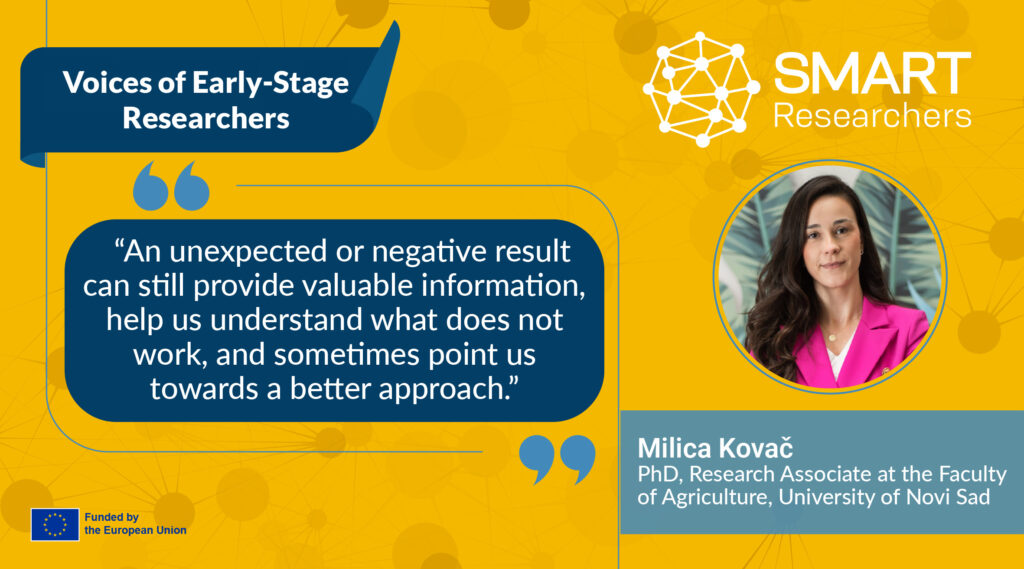
Milica Kovač, PhD, Research Associate at the Faculty of Agriculture, University of Novi Sad, shares insights into her research journey, the challenges she has faced, the importance of professional connections and mentorship, and her advice for early-career researchers.
What motivated you to choose your research field or topic, and how did you get started?
As a Landscape Architecture student, during my undergraduate studies I was introduced to subjects related to ecology, biodiversity, and agroforestry. I have always been fascinated by how much we benefit from trees and forests, from providing fruits and raw materials to improving air quality, stabilising soils, and protecting crops, and by how little we sometimes do to support and protect them. This interest gradually motivated me to explore the role of trees and forests in sustainable landscapes and agricultural systems.
How did you learn the skills and methods needed at the beginning of your research career?
At the beginning of my research career, I focused on understanding the field theoretically—reviewing existing research, what had already been done, and the methods that had been used. Once we defined the specific research topic, I began with field and laboratory work. Fieldwork, including sample collection and the assessment of environmental conditions, was extremely important, but also relatively familiar to me.
The biggest challenge was the laboratory work, as it was completely new to me. However, I received a great deal of support from my mentors and more experienced colleagues, who guided me through the methodologies and helped me develop the practical skills I needed. Their support and willingness to share their knowledge played an important role in building my confidence and developing my research skills.
Which career-related resources (mentoring, training, mobility programs, networks) have supported your professional growth so far?
For me personally, especially at the beginning of my career, mentoring was the main source of support. My mentors provided guidance, shared their experience, and helped me develop both my research skills and confidence. As my work developed and I started working on different projects and with different teams, I realised how important networking is. I met many people with similar interests and learned a great deal through these professional connections. Being part of professional networks has allowed me to exchange knowledge, learn from colleagues from different backgrounds, and discover new opportunities for collaboration and professional development.
How do you collaborate with supervisors, colleagues, or project partners?
A doctorate is not something that can be completed in a week or two, it is usually several years of work, research, and collaboration with people with different experiences, perspectives, and working styles. Including my other professional experiences before and after my doctorate, I have almost 10 years of work experience behind me, which means I have had the opportunity to work with many different people and teams.
I cannot say that every collaboration has always been ideal or that I have always had the support I needed; there have also been challenging and sometimes unpleasant situations. However, fortunately, I have built good relationships with most of the people I have worked with. In my experience, colleagues and project partners are generally willing to share their knowledge, support each other, and help find solutions, especially when working towards a common goal. I value open communication, mutual respect, and a willingness to help each other, as these are essential for successful collaboration.
Can you share a moment when collaboration helped you achieve something significant?
One example that stands out is the laboratory part of my research, which was quite new to me, especially the work related to plant biochemistry. The support of my colleagues was extremely valuable, not only in helping me understand what information and results we could obtain from the analyses, but also in teaching me how to carry out the methods and interpret the results.
Also, many of the projects I have been part of were successful precisely because more experienced colleagues were willing to guide us in the right direction, explain the requirements, and help us turn ideas into practical research activities. Their support often made the difference between simply having an idea and being able to successfully implement it.
How do you build professional networks, online or at conferences, and how has that helped your research?
Sometimes I hear about an interesting topic at a conference and that gives me a reason to connect with someone. Sometimes, during online meetings, project partners introduce me to someone whose expertise is relevant to my work. I also use LinkedIn and other professional platforms to find people with similar research or professional interests. However, most of my professional connections have developed quite organically, by simply staying open to conversations and opportunities.
These connections have helped me meet the right people at the right time, discover interesting research projects, exchange knowledge and experiences, and, in some cases, find new professional and career opportunities. I have also learned that networking is not only about actively looking for opportunities, it is about building genuine professional relationships that can become valuable over time.
How has mentorship or coaching influenced your development as a researcher?
Mentorship has had a significant influence on my development as a researcher. My PhD supervisors support and guidance encouraged me to step outside my comfort zone and take opportunities that I might not have pursued on my own. Their supervisors helped me develop not only my scientific skills but also a broader understanding of research, collaboration, and working in an international environment.
What has been the biggest challenge in your research, and how did you overcome it?
In my case, and even though I had great support from many of my colleagues, one of the biggest challenges was working with people who were not always willing to cooperate or share their experience. This sometimes slowed down the research process and meant that I had to spend more time finding information and developing solutions independently. However, it also taught me to be more resourceful, persistent, and willing to explore different approaches, and in some cases it even led me to find better solutions.
From a scientific perspective, the biggest challenge was bringing together several scientific fields into one meaningful research approach and mastering methodologies that were outside my original field of expertise. I overcame this through continuous learning, consulting experts in different fields, and working closely with colleagues who had complementary knowledge and experience. This experience taught me that interdisciplinary research can be challenging, but also that combining different perspectives can lead to much stronger results.
Have you faced limitations related to funding, infrastructure, or institutional support? How did you handle them?
The main limitations I experienced were related to infrastructure and access to equipment. For example, our institute had a limited number of microscopes, while several researchers needed to use them for their work at the same time. This required careful planning, coordination, and negotiation to make sure that everyone had enough time to carry out their research. At times, this could slow down the research process, but a willingness to communicate, coordinate, and compromise allowed us to manage the available resources effectively and ensure that everyone could complete their work.
How do you manage setbacks or unexpected results?
Uh, this is definitely something I have learned over time. It can be especially difficult when you have invested a lot of time and effort into something and it does not work out, particularly when the reasons are external and beyond your control. However, dedication to the goal and the desire to keep progressing help me move forward rather than give up. One thing that has helped me develop this mindset is something my mentor used to say: “Even a bad result is a result.” An unexpected or negative result can still provide valuable information, help us understand what does not work, and sometimes point us towards a better approach.
How do you balance research workload, deadlines, and personal life as an early-stage researcher?
I try to maintain clear boundaries between my work and personal life. Sometimes this can be difficult, especially when deadlines are approaching or when research cannot wait. This is particularly true when working with plants, as some research activities depend on specific stages of the vegetation period and cannot simply be postponed. I try to organise my time carefully and set clear priorities and deadlines, although I admit that I do not always succeed in maintaining the balance I would like. What is important to me is that no matter how many commitments I have, I find time for myself because it helps me to continue my work tomorrow with the same enthusiasm and desire and not to let myself burn out.
How do you see your research contributing to society or advancing your field?
I see my research contributing to the conservation and sustainable management of the genetic resources of common walnut (Juglans regia L.). Walnut has important ecological and economic value, and maintaining its genetic diversity is essential for its ability to adapt to changing environmental conditions, including climate change. My research focused on the genetic and phenotypic variability, providing insights into its adaptive potential and the importance of preserving this diversity. I hope that these findings can contribute to better conservation strategies, both in situ and ex situ, and support the sustainable use of walnut and other species in forestry and agroforestry systems.
What advice would you give to researchers in general?
First and foremost, patience. I would advise researchers to be patient and consistent. Research rarely progresses fluently, sometimes everything works as expected, and the next moment things can become much more complicated. What is important is not to give up during those moments, but to keep your goal in mind and continue working towards it. No one has had an easy research journey, and if you have already come this far, you can keep going. In the long run, consistent effort usually brings results. At the same time, I think it is important to remember that research is only one part of life, taking care of your personal life and well-being is equally important for having the energy and motivation to continue your research journey.
One thought on “Voices of Early-Stage Researchers: Milica Kovač”