Voices of Early-Stage Researchers: Ilias Bellas
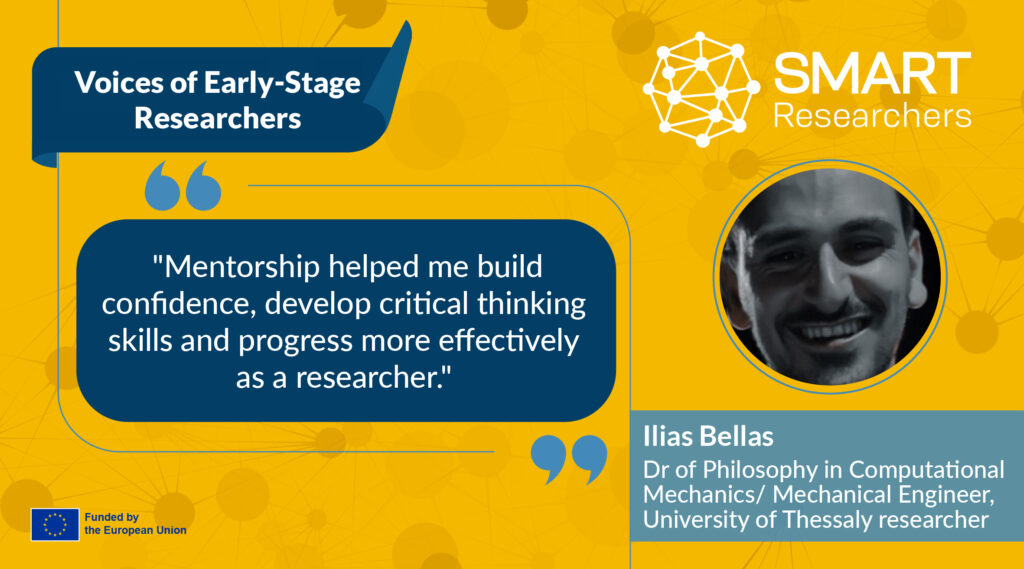
Ilias Bellas, Dr of Philosophy in Computational Mechanics/ Mechanical Engineer, and researcher at the University of Thessaly, shares insights into his research journey, the mentors who have shaped his career, what motivated him to pursue a path in research, and the challenges that have contributed to his growth as a researcher.
What motivated you to choose your research field or topic, and how did you get started?
My interest in this research field developed gradually through my prior exposure to microstructural phenomena in materials. I had already been involved with related aspects of microstructure, and when I was given the opportunity to explore these mechanisms from the perspective of computational mechanics, I found the challenge particularly compelling. The combination of physical insight at the microscale with advanced numerical modeling tools motivated me to pursue this topic further and ultimately shaped the direction of my research.
How did you learn the skills and methods needed at the beginning of your research career?
At the beginning of my research career, I learned the necessary skills and methods through guidance from my supervisor, who had a postdoctoral researcher working with me and providing day-to-day direction. This guidance helped me understand both the theoretical foundations and the practical aspects of the field. In parallel, I strengthened my background through independent study and extensive reading of the relevant literature.
Which tools, software, or research infrastructure have been most helpful in your daily work?
In my daily work, I mainly use Abaqus for finite element simulations, FORTRAN for model implementation, Excel for data handling, Origin for post-processing and visualization, and Mathematica for analytical calculations and verification.
Which career-related resources (mentoring, training, mobility programs, networks) have supported your professional growth so far?
My professional growth has been mainly supported by mentoring from my supervisor and senior researchers, as well as through on-the-job training during my research work. Informal academic networks and discussions with colleagues have also played an important role in shaping my research perspective.
How do you collaborate with supervisors, colleagues, or project partners?
I collaborate very effectively with supervisors, colleagues, and project partners through regular communication, clear coordination of tasks, and constructive exchange of ideas.
Can you share a moment when collaboration helped you achieve something significant?
A significant example was my collaboration with colleagues that helped me better describe and understand the mechanical behavior of polycrystalline materials. Through discussions and exchange of ideas, I was able to refine my approach and improve the interpretation of my results.
How do you build professional networks, online or at conferences, and how has that helped your research?
I build professional networks mainly through conferences, academic meetings, and direct communication with researchers working in related fields. These interactions have helped me exchange ideas, receive feedback on my work, and gain broader perspectives that have positively influenced my research.
How has mentorship or coaching influenced your development as a researcher?
Mentorship has played a key role in my development by providing direction, constructive feedback, and guidance in both research methodology and problem-solving. This support helped me build confidence, develop critical thinking skills, and progress more effectively in my research work.
What has been the biggest challenge in your research, and how did you overcome it?
One of the biggest challenges in my research was addressing difficulties at both the programming level and in the development and implementation of complex constitutive models. I overcame these challenges by starting with simplified problems and gradually moving toward more advanced formulations. This step-by-step approach helped me validate my work, build confidence in the methodology, and successfully apply the models to more complex cases.
Have you faced limitations related to funding, infrastructure, or institutional support? How did you handle them?
No, I did not face significant limitations related to funding or infrastructure. Fortunately, the nature of my research was primarily computational and did not require extensive experimental equipment, which allowed me to carry out my work effectively with the available resources.
How do you manage setbacks or unexpected results?
When I encounter setbacks or unexpected results, I take a step back to better understand the overall picture. I return to the last step where I was confident in the results and then proceed more carefully and gradually toward the point where the issue arose. This approach helps me identify the source of the problem and move forward in a controlled and reliable way.
How do you balance research workload, deadlines, and personal life as an early-stage researcher?
Balancing research workload, deadlines, and personal life has been challenging, particularly during the PhD stage. While achieving a perfect balance was not always possible, I learned to manage priorities, adapt to demanding periods, and gradually develop better time-management skills through experience.
How do you see your research contributing to society or advancing your field?
My research contributes to the advancement of computational mechanics by improving the understanding and modeling of complex deformation mechanisms in crystalline materials. The developed methodologies enhance the predictive capability of numerical simulations, which can support the design and assessment of advanced materials used in engineering applications.
What career paths are you currently considering, and how does your institution support these options?
I am currently considering both research-oriented and industrial career paths. My institution supports these options by providing a strong research environment, opportunities to develop advanced technical skills, and exposure to applied projects that are relevant to both academic and industrial settings.
Which emerging trends, technologies, or approaches in your field excite you the most?
I find developments in data-driven methods and artificial intelligence particularly exciting, especially their potential to complement computational mechanics. I am interested in further exploring these approaches and integrating them into my research in the future.
What advice would you give to researchers in general?
I would advise researchers to be patient, as research is a long but rewarding journey. It is also important to be precise and consistent in their work, as rigor and perseverance are essential for meaningful scientific progress.