Voices of Early-Stage Researchers: Milica Živković
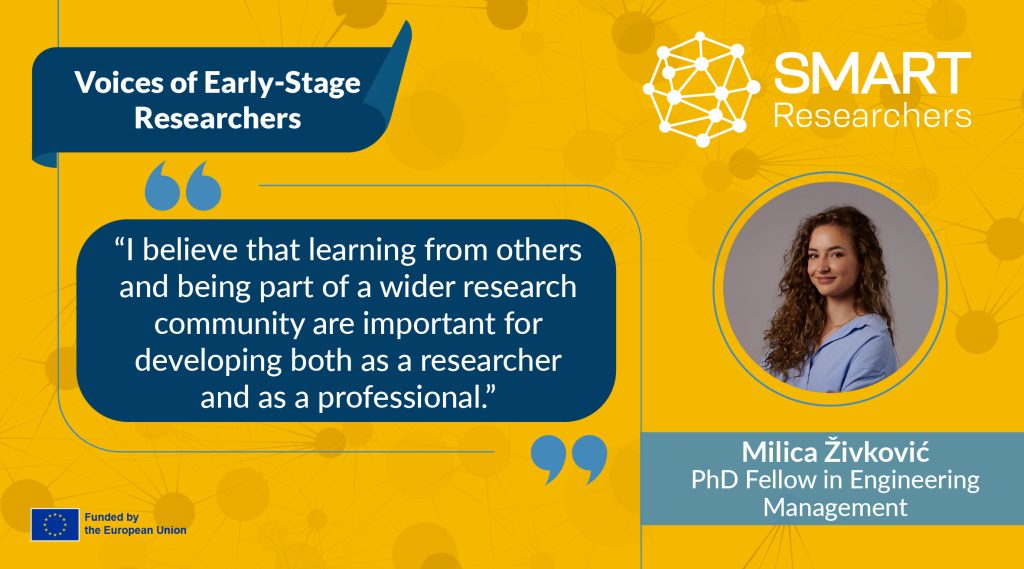
Milica Živković, PhD Fellow in Engineering Management, shares insights into her research journey, the role of mentorship and how she builds and maintains professional connections.
What motivated you to choose your research field or topic, and how did you get started?
My research interests developed gradually throughout my academic journey. I initially became interested in Kaizen and process improvement, which led me to explore how organizations can work more efficiently. Over time, I became increasingly interested in artificial intelligence and its potential to improve project management, particularly in areas such as planning, decision-making, and risk management. My doctoral studies have given me the opportunity to explore the intersection of technology and management in greater depth.
How did you learn the skills and methods needed at the beginning of your research career?
I developed my initial research skills through university courses, guidance from professors, and writing my bachelor’s and master’s theses. These experiences gave me a solid foundation, which I continued to build through independent learning and practice. I gradually expanded my knowledge of scientific literature searches, source evaluation, and research methodologies, while continuously refining my approach to academic research.
Which tools, software, or research infrastructure have been most helpful in your daily work?
Zotero has been particularly useful for managing references and organizing scientific literature, while Scopus and Google Scholar help me find relevant publications. I also use ResearchGate to discover researchers and their work, Excel to organize research data, and Jamovi for statistical analysis. Grammarly helps me improve the clarity and language of my academic writing, and Claude supports data analysis and helps me identify patterns in research findings.
Which career-related resources (mentoring, training, mobility programs, networks) have supported your professional growth so far?
Mentorship has played an important role in my development. The guidance I received during my undergraduate and master’s studies, and especially the support of my doctoral supervisor, have helped me gradually develop my research interests and become more confident in my academic work. Conferences and international activities have also given me opportunities to exchange ideas, meet researchers from different backgrounds, and build professional connections. I believe that learning from others and being part of a wider research community are important for developing both as a researcher and as a professional.
How do you collaborate with supervisors, colleagues, or project partners?
I collaborate through email, social media, and in-person or online meetings. Conferences and professional events are also valuable opportunities to exchange ideas, discuss research interests, and connect with people who have different perspectives and expertise.
Can you share a moment when collaboration helped you achieve something significant?
One valuable experience has been connecting with a project manager who shares my interests and is an alumnus of a student organization I was involved in. Our conversations have given me a better understanding of the practical side of project management and allowed me to learn from his professional experience. These exchanges have helped me connect academic interests with real-world perspectives and think more concretely about how to approach my research.
How do you build professional networks, online or at conferences, and how has that helped your research?
I build professional connections by attending conferences, networking events, and activities that bring together researchers and professionals. For example, attending a Eurodoc Conference gave me the opportunity to meet other doctoral researchers and learn about their topics and experiences.
How has mentorship or coaching influenced your development as a researcher?
My doctoral supervisor’s mentorship has been particularly valuable in helping me refine my research direction, think more critically, and become more independent. I have also learned how to approach academic writing more systematically and identify relevant conferences and other research opportunities. Beyond specific advice, having a good example to learn from has helped me better understand what it means to develop as a researcher.
How do you balance research workload, deadlines, and personal life as an early-stage researcher?
Balancing research, work, and personal life requires good organization and conscious prioritization. I try to plan ahead, focus on what matters most at any given time, and avoid leaving tasks until the last minute. At the same time, I believe productivity isn’t just about how much you accomplish, but also about maintaining a healthy balance. Making time for sports, hobbies, and the people close to me helps me recharge, stay focused, and maintain a sustainable routine.
Which emerging trends, technologies, or approaches in your field excite you the most?
I am particularly interested in generative AI and AI agents, and how they can be applied in project management. I’m excited to explore how these technologies can support project planning, risk management, and decision-making, and how they are shaping the future role of project managers.
What advice would you give to researchers in general?
Stay curious, remain open to new perspectives, and approach your work systematically. Research requires continuous learning, so ask questions, explore different approaches, and don’t limit yourself to what you already know.
I also encourage researchers to take time early on to understand which tools and resources are available and useful to them. Finding the right tools early can make the research process more efficient and leave more time for what matters most: critical thinking and meaningful insights.
Another important thing is building connections with people both within and outside your field. Some of the most valuable ideas and perspectives can come from conversations with people who have expertise in different areas.
Finally, do not let research become your entire life. Make time for your hobbies, physical activity, friends, and family. Taking a break is not a distraction from being a good researcher, it can help you return to your work with fresh energy, better concentration, and new perspectives. In the long run, maintaining that balance is just as important as working hard.