Voices of Early-Stage Researchers: Sandra Kolarić
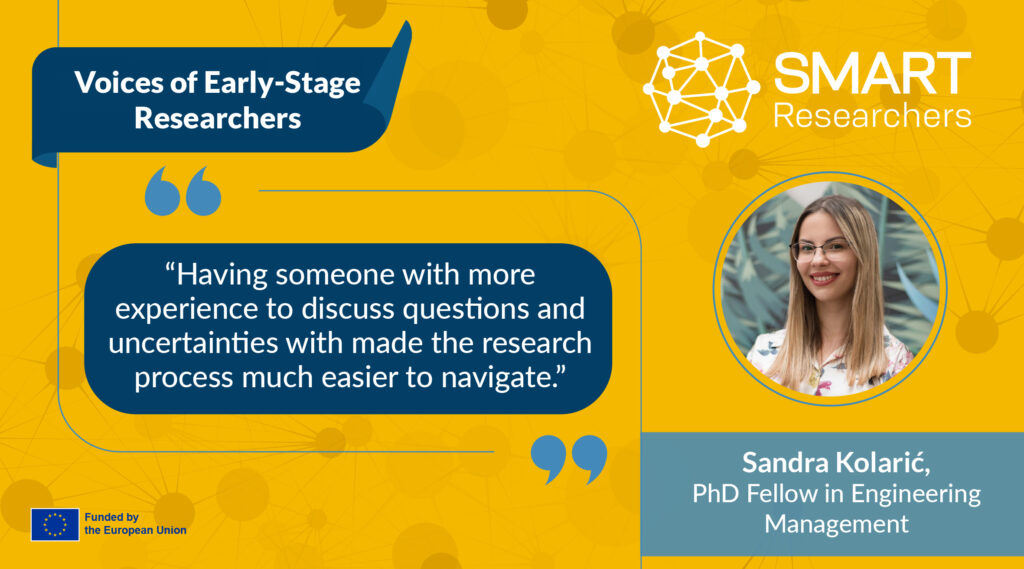
Sandra Kolarić, PhD Fellow in Engineering Management, shares insights into her research journey, the role of mentors along the way, the tools she uses, how she builds and maintains professional connections, and more.
What motivated you to choose your research field or topic, and how did you get started?
My research is within Engineering Management, with a particular interest in marketing and neuromarketing. My interest in neuromarketing developed during my university studies, when one of my professors introduced me to the field and to researchers working in this area in Serbia. I found the combination of marketing, consumer behaviour and scientific methods particularly interesting. Since neuromarketing is still a relatively under-researched area in Serbia, I became interested in exploring it further through my academic work.
How did you learn the skills and methods needed at the beginning of your research career?
I developed the basic research skills and methods through courses during my bachelor’s and master’s studies, as well as through working on my master’s thesis. This gave me experience in literature research, academic writing, data collection and analysis. My first year of doctoral studies also helped me strengthen these foundations, while guidance from my mentor was particularly useful in understanding how to approach research more systematically.
Which tools, software, or research infrastructure have been most helpful in your daily work?
In my research, I have mainly used Scopus and Google Scholar to identify relevant academic literature and follow existing research in the field. I also use Zotero to organise and manage academic references. For working with and organising data, Excel has been particularly useful.
Which career-related resources (mentoring, training, mobility programs, networks) have supported your professional growth so far?
Mentoring has been one of the most important forms of support in my academic development. In addition, my involvement in a student organisation during my bachelor’s studies gave me an early opportunity to participate in workshops, training and networking activities. Although these activities were not directly related to my research topic, they helped me develop communication, organisational and teamwork skills that have been valuable throughout my academic and professional development.
How do you collaborate with supervisors, colleagues, or project partners?
I usually collaborate with my supervisor, colleagues and project partners mainly through email, online communication and meetings when needed. Collaboration involves exchanging ideas, discussing research questions, sharing information and asking for feedback when needed. In my current work, working with people from different academic and professional backgrounds has also helped me look at research and its communication from different perspectives.
How do you build professional networks, online or at conferences, and how has that helped your research?
I have built my professional network through university activities, student organisations, workshops, conferences, professional events and online platforms such as LinkedIn. Working on EU-funded projects has also allowed me to interact with researchers and professionals from different countries and disciplines.
How has mentorship or coaching influenced your development as a researcher?
Mentorship has been particularly important during the early stages of my research. My mentor helped me understand how to approach a research topic, provided feedback on my ideas and guided me through some of the methodological and academic aspects of my work. Having someone with more experience to discuss questions and uncertainties with made the research process much easier to navigate.
What has been the biggest challenge in your research, and how did you overcome it?
One of the biggest challenges has been the limited amount of research available on the specific topic I am interested in, particularly the intersection of neuromarketing, artificial intelligence and people’s responses to AI-generated content. Neuromarketing itself is an interdisciplinary field that combines elements of marketing, neuroscience and psychology, so to address this, I have looked separately at these different fields and explored the existing research in each of them. By doing this, I can gradually bring together findings from different areas and build a broader understanding of the topic, while also identifying areas where further research is needed.
How do you balance research workload, deadlines, and personal life as an early-stage researcher?
Balancing research, professional responsibilities and personal life can be challenging, particularly when several deadlines overlap. I try to manage this by prioritising tasks, planning ahead and breaking larger pieces of work into smaller steps. I have also learned that research requires flexibility, as some tasks inevitably take longer than expected.
How do you see your research contributing to society or advancing your field?
I see neuromarketing as a field that can contribute to a better understanding of how people perceive and respond to different forms of communication. Traditional marketing research often relies on what people say about their preferences and behaviour, while neuromarketing can provide additional insights into the cognitive and emotional responses underlying those behaviours. As the way people interact with brands and digital content continues to change, I believe this type of research can help us better understand consumer decision-making and develop more informed approaches to communication and marketing. I am particularly interested in how this field can develop alongside new technologies such as AI. Although this is still an emerging area of research, understanding how people respond to AI-generated content could eventually contribute to more effective and responsible use of AI in marketing and communication.
Which emerging trends, technologies, or approaches in your field excite you the most?
One of the areas I find particularly interesting is the development of artificial intelligence and its growing role in marketing and communication. I am especially interested in the possibility of combining AI-related research with neuromarketing methods to understand not only what people say about AI-generated content, but also how they actually respond to it. More broadly, I think the increasing intersection between AI, neuroscience, psychology and marketing will create interesting opportunities for future research.
One thought on “Voices of Early-Stage Researchers: Sandra Kolarić”