Voices of Early-Stage Researchers: Nadiia Khakimova
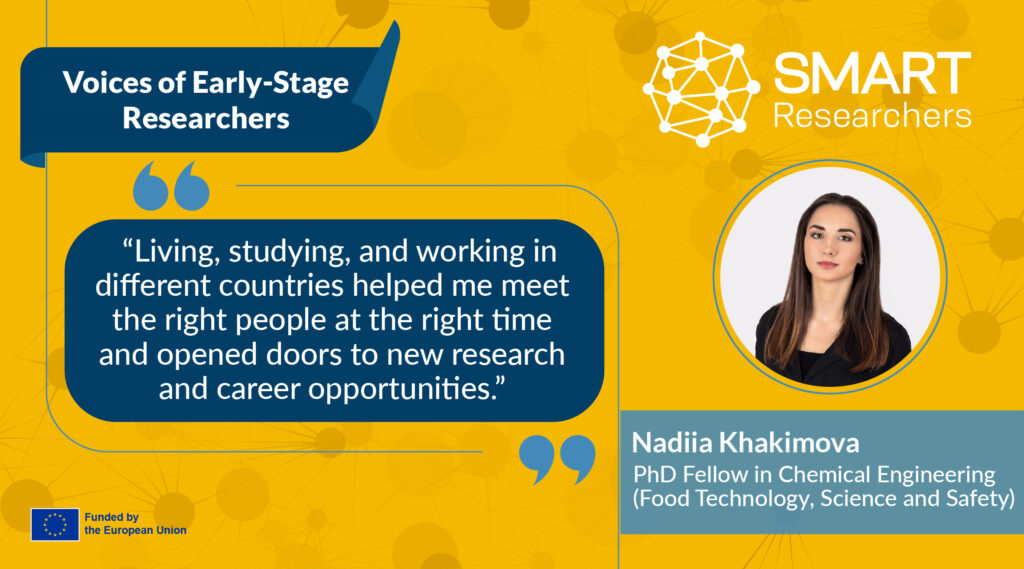
Nadiia Khakimova, PhD Fellow in Chemical Engineering, shares insights into her research journey, highlighting the value of international experience, collaboration, and mentorship.
What motivated you to choose your research field or topic, and how did you get started?
I was initially interested in cosmetics and wanted to work with perfumes. When I started looking into which degree would allow me to enter this field, I discovered food technology, which was the closest available option in Ukraine and had quite a lot in common with cosmetics and perfume technology. Over time, I realised how broad food technology is and that food will always be an essential industry. I gradually became very interested in the subjects and later continued with an MSc in Food Science and Safety abroad.
How did you learn the skills and methods needed at the beginning of your research career?
At the beginning, we had a strong combination of theoretical courses and laboratory work. Food technology programmes in Ukraine are quite practical and traditionally prepare engineers for direct work in industry. During the third and fourth years of my Bachelor’s degree, I also started working during the summer and later part-time in a laboratory carrying out research and analytical work for private industry. This gave me valuable practical experience alongside my studies.
Which career-related resources (mentoring, training, mobility programmes, networks) have supported your professional growth so far?
One of the biggest steps in my professional development was completing my MSc abroad. An Erasmus+ traineeship and the support of my supervisors and mentors also played an important role in my development as a researcher.
Can you share a moment when collaboration helped you achieve something significant?
My PhD research is highly multidisciplinary, so collaboration has been essential throughout the process. I have worked with and received advice from colleagues in areas such as analytical chemistry, microbiology, and genetic engineering. Without their expertise and consultations, it would have been very difficult to carry out all parts of the research independently and achieve the same quality of results.
How do you build professional networks, online or at conferences, and how has that helped your research?
For me, professional networking has developed quite naturally through living, studying, and working in different countries and meeting people from different scientific and professional backgrounds. These connections have helped me meet the right people at the right time, discover interesting research projects, exchange knowledge, and in some cases even find new professional and job opportunities.
How has mentorship or coaching influenced your development as a researcher?
Mentorship has had a significant influence on my development as a researcher. My MSc and PhD supervisors helped me develop not only scientific skills but also a broader understanding of research and international collaboration. Their support and guidance also encouraged me to gain international experience and take opportunities that contributed strongly to my professional development.
What has been the biggest challenge in your research, and how did you overcome it?
One of the biggest challenges has been the multidisciplinary nature of my PhD research. It required me to work with methods and concepts from several scientific fields, sometimes outside my main area of expertise. I addressed this by learning continuously, consulting specialists in those fields, and collaborating with colleagues rather than trying to solve every problem completely independently.
How do you manage setbacks or unexpected results?
When I encounter unexpected results, I usually start by reviewing the experimental process and considering what might have gone wrong. Depending on the situation, I repeat experiments, check the methodology and literature, and consult colleagues who have more experience with the specific method or research area. Discussing the problem with someone else often helps to identify issues that are difficult to notice when working alone.
How do you balance research workload, deadlines, and personal life as an early-stage researcher?
I try to keep quite clear boundaries between work and personal life. I generally do not work at weekends, and even during my PhD this only happened a few times. I set clear deadlines, use structured time-management practices, and try to work efficiently during working hours. I have also learned to say no when I can see that taking on additional tasks would make it difficult to manage my existing responsibilities properly.
How do you see your research contributing to society or advancing your field?
My research focuses on food science, so I hope it can contribute to the development of more sustainable food systems. In particular, research in this area can support the discovery of new sources of bioactive compounds, better use of existing resources, and the development of technologies that may help produce nutritious food more sustainably and support future food security.
Which emerging trends, technologies, or approaches in your field excite you the most?
I am particularly interested in cellular agriculture and the development of alternative and more sustainable food production systems. I am also interested in more holistic approaches to food science that connect nutrition, health, sustainability, processing, and consumer behaviour rather than studying them separately. Precision fermentation and the use of biotechnology to develop new food ingredients and bioactive compounds are also areas that I find particularly promising.
What advice would you give to researchers in general?
I would advise researchers to be patient and consistent. Research rarely progresses in a straight line, and there will naturally be periods when everything works well and periods when very little seems to work. In the long term, consistent effort usually brings results. I also think it is important to remember that research is only one part of life, not your whole life, so taking care of other aspects is equally important.
One thought on “Voices of Early-Stage Researchers: Nadiia Khakimova”