Voices of Early-Stage Researchers: Aleksandra Hornjak
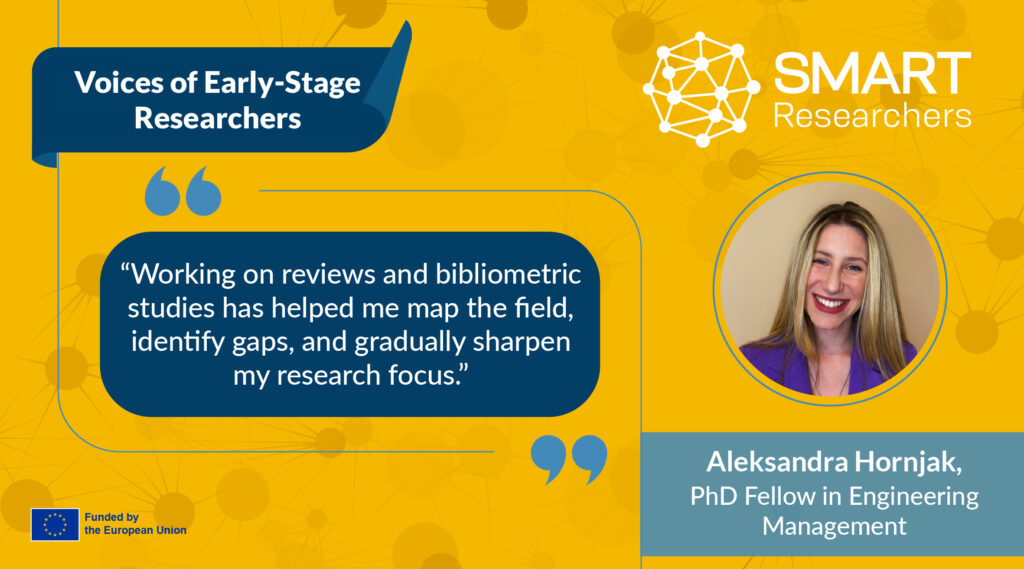
Aleksandra Hornjak, PhD Fellow in Engineering Management, talked to us about developing the skills and methods needed for a research career, the role of mentorship and support, the gaps she sees in the field, how she balances an early-stage research career with her personal life, and much more. Discover her journey and the experiences shaping her path in research.
What motivated you to choose your research field or topic, and how did you get started?
I became interested in information technology during my third year of undergraduate studies in Engineering Management, when several courses showed me how IT shapes the way organisations are managed. In my final year I decided on the Information Management module to see how the two fields could be combined. During my master’s studies, I started working as a teaching assistant at the faculty where I completed my bachelor’s degree. After graduating, I enrolled in doctoral studies there in 2024, and I still work at the same faculty.
How did you learn the skills and methods needed at the beginning of your research career?
Mostly by doing and by watching more experienced colleagues, with a lot of support from my colleagues and advisors along the way. I also learned a lot from reading how-to literature. Writing my bachelor’s and master’s theses gave me my first research experience. My first conference papers, literature reviews on AI in e-government and on ERP implementation, then taught me how to search databases, screen studies, and structure a review. From there, I moved on to bibliometric and foresight methods, which I learned mostly from the methodological literature.
Which tools, software, or research infrastructure have been most helpful in your daily work?
I mostly use Scopus as the primary database for my research, followed by Google Scholar. When working with data, I use VOSviewer for network analysis and Zotero for managing references. A large part of my analysis is still done in Excel, which gives me full control over screening and coding the data.
Which career-related resources (mentoring, training, mobility programs, networks) have supported your professional growth so far?
The most valuable support has come from my colleagues at work, where informal mentoring is part of everyday work. Participating at conferences has also been important for getting feedback and meeting researchers from other institutions. I also research courses online, broadening my knowledge.
How do you collaborate with supervisors, colleagues, or project partners?
Collaboration at our department is very close: besides teaching courses together, we motivate each other and share ideas and contacts. With my advisor, I work step by step, sharing drafts and methodological decisions. We communicate by e-mail and through shared spreadsheets, but we also have regular meetings.
Can you share a moment when collaboration helped you achieve something significant?
A good example is the conference my colleagues and I have organised together. We collaborated on everything, from the initial idea and planning to running the event itself. It shows how much a team can achieve when everyone brings their strengths and is eager to contribute.
What has been the biggest challenge in your research, and how did you overcome it?
The biggest challenge has been narrowing my focus, because the area where information systems and management meet offers so many interesting directions. Working on reviews and bibliometric studies has helped me map the field, see where the gaps are and gradually sharpen my research.
How do you balance research workload, deadlines, and personal life as an early-stage researcher?
Teaching, research and deadlines can pile up, so I try to plan ahead and keep time for life outside academia. I teach and dance traditional dances, enjoy spending time outdoors, and I always make time for family and friends. That balance keeps me motivated and productive at work.
How do you see your research contributing to society or advancing your field?
My research uses methods to spot emerging topics and weak signals before they become mainstream. This can help researchers, educators and decision-makers respond in time.
What advice would you give to researchers in general?
Look for an environment where people support each other, because research is easier and more enjoyable as a team effort. Every step, even an imperfect one, teaches you something and brings you closer to your own research direction
One thought on “Voices of Early-Stage Researchers: Aleksandra Hornjak”